

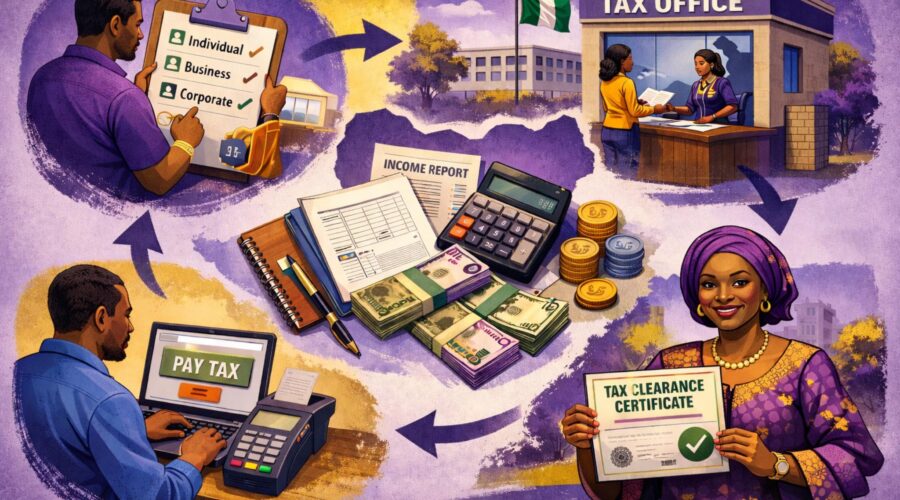
How to register, file and PAY your taxes correctly in Nigeria
Paying taxes in Nigeria is no longer just a civic obligation for large corporations or salary earners alone. It is now an essential component of how individuals, entrepreneurs, freelancers, startups, and multinational corporations legally operate, obtain government services, and avoid penalties.
With Nigeria’s push to expand its tax base and digitise revenue collection, knowing how to properly pay your taxes has become critical for anyone earning a living in the country.
The following 5-step-by-step guide is a clear, practical, and simplest ways to pay taxes in Nigeria, written simply and in the right order so anyone can follow it, whether you’re an employee, freelancer, business owner, or company.
STEP 1: Confirm the type of taxpayer you are
The first thing is to identify who you are for tax purposes.
If you earn a salary from an employer, you fall under PAYE (Pay-As-You-Earn).
If you run a business, freelance, consult, trade, or earn side income, you are self-employed.
If you registered as a company, you are taxed as a corporate entity.
Employees pay personal income tax through PAYE deductions handled by their employer.
Self-employed individuals pay personal income tax based on their annual income.
Companies pay company income tax, value-added tax (VAT), withholding tax, and other applicable statutory taxes.
- This step matters because it determines where you register, which tax authority you deal with, and what taxes apply to you.
STEP 2: Register with the correct tax authority
Registration is mandatory before you can legally pay tax.
Employees and self-employed individuals register with the State Internal Revenue Service (SIRS) in the state where they live or operate. Companies register with the Federal Inland Revenue Service (FIRS) after incorporation with CAC.
To register for a Tax Identification Number (TIN) in Nigeria, individuals and businesses
Visit the Joint Tax Board (JTB) TIN registration portal – https://tin.jtb.gov.ng/ or Nigeria revenue services, ‘tax ID portal’ – https://taxid.nrs.gov.ng/
The process is free and requires your Bank Verification Number (BVN) or National Identification Number (NIN) to verify existing records or register a new one.
- During registration, your personal or business details are captured, and you are issued a Tax Identification Number (TIN). This TIN is permanent and must be used for all tax payments, filings, and official correspondence.
STEP 3: Prepare your income and financial records
Before filing or paying tax, gather your financial information.
This includes salary slips, bank statements, invoices, receipts, contracts, payroll records, or audited accounts for companies.
Your tax is calculated based on actual income, not guesswork.
- Proper records protect you during audits and ensure your assessment is accurate.
STEP 4: Pay your tax through approved channels
Tax payments must be made through official government channels only. Payments are made via online platforms such as;
e-Tax (LIRS) – https://etax.lirs.net/
Remita – https://support.remita.net
Flutterwave – https://flutterwave.com or
Interswitch QTB – https://corporate360.interswitchgroup.com
Let’s say for self-service payment;
- Visit the state Internal Revenue Service (IRS) website https://irs.en.gov.ng/home
- Click “Pay with” and select a payment gateway.
- Enter your bill number/tax ID and payment amount.
Payments are made via designated banks, online tax portals, or government payment platforms using your TIN and assessment reference number.
- After payment, you receive an official receipt or electronic confirmation. This receipt is your legal proof that tax has been paid.
STEP 5: Collect your Tax Clearance Certificate (TCC)
Once your tax has been fully paid and confirmed, you can apply for a Tax Clearance Certificate.
- The TCC proves that you are tax-compliant and is often required for:
- government contracts
- visa and immigration processing
- loans and grants
- land and asset transactions
- corporate and regulatory filings
Final takeaway and conclusion
Register first, get your TIN, understand your tax type, file honestly, pay through official channels, keep records, and repeat every year.
That is the correct and complete way to register, file, and pay taxes in Nigeria legally, safely, and without trouble.
Visit https://irs.en.gov.ng/home or https://etax.lirs.net/ for more information

Related Posts

A gathering of visionaries: Enugu Tech Festival 2026 targets over 50,000 participants
From Coal City to Code City, the Enugu Tech Festival 2026 brings together over 50,000 innovators, global tech leaders, and investors to shape Africa’s ambitious digital future.

$5,000 Tony Elumelu foundation grant for African Entrepreneurs 2026: How to apply and win
Apply for the 2026 Tony Elumelu Foundation $5,000 grant and gain funding, mentorship, and training to launch or grow your African startup. Deadline: March 1.

Zero tariffs: China opens Its doors to 53 African nations, including Nigeria, Kenya, South Africa, Ghana and others
China opens its vast market to Africa tariff-free from May 1, 2026, unlocking bold new export opportunities and reshaping the continent’s trade future.

FG & Ericsson set sights on 50,000 Nigerian youths in game-changing NextGen hackathon revolution
FG and Ericsson launch a bold hackathon to empower 50,000 Nigerian youths with AI, cloud and 5G skills—fueling innovation, jobs and global tech impact.

Google Opens Applications for Class 10 of Its Startup Accelerator in Africa, With a Strong AI-First Focus
Google has opened applications for Class 10 of its Startup Accelerator Africa marking a shift toward an AI first approach designed to support research driven startups across the continent. The 12 week hybrid program targets Series A companies building scalable artificial intelligence solutions for African markets while offering equity free support technical expertise and access to Google Cloud infrastructure.