

Nigeria Approves Digital Postcode Systems To Fix Address Problems Nationwide
Nigeria enters into an age of digital postcodes
The federal government has approved the installation of a GIS-enabled alphanumeric digital postcode system, which would allow for faster and more reliable mail and parcel processing throughout Nigeria.
Minister of Communications, Innovation, and Digital Economy, Bosun Tijani, announced the approval on Wednesday, 4th March 2026, following a Federal Executive Council (FEC) meeting in Abuja presided over by President Bola Tinubu.
Recall
In 2023, the ministry released its strategy framework, “Accelerating Our Collective Prosperity through Technical Efficiency”, which, according to Mr Tijani, will drive efforts to promote ICT use and optimise communications infrastructure across the country.
In his statement at the meeting in Abuja, the minister of Communications, Innovation, and Digital Economy, Bosun Tijani, emphasised that the digitalisation of the post system, as part of the communication ministry’s strategic roadmap, promotes accurate, rapid, and reliable mail and parcel processing in the country in conjunction with the Nigerian Postal Service.

“Working in collaboration with the Postmaster General of the Federation, Tola Odeyemi and her team at the Nigerian Postal Service, who worked hard on delivering this, we will introduce a modern, geospatial-intelligent addressing system that improves accuracy across the country and enables faster and more reliable mail and parcel processing,” Mr Tijani explained.
The communication minister also stated that the digital postcode system will improve national planning, emergency response, and the effective delivery of government services and that digitising the postcode system will make it easier to connect people across the country.
“Beyond strengthening postal operations, the Digital Postcode System will also serve as an important national enabler supporting better national planning, improved emergency response, more efficient logistics and e-commerce, and the delivery of government services.”
“As our digital economy continues to grow, foundational systems such as this play an essential role in building the infrastructure required to connect people, businesses, and services more efficiently across the country.”
“This approval represents another step forward in our commitment to building the enabling environment to support a modern, inclusive, and globally competitive digital economy,” the minister said.
With this Federal Executive Council’s (FEC) adoption of alphanumeric digital postcode system, Nigeria is making significant progress toward modernising its national addressing system
Nigeria has had a disjointed and inconsistent addressing system for many years. Postal services have had difficulty effectively delivering mail or packages; many streets lack names, and many buildings lack numbers. Therefore, the FEC’s approval is not just a postal service reform; it is a fundamental milestone in the history of the country.
The 17-year wait
After almost 20 years of attempts to change Nigeria’s addressing system, the digital postcode system has been introduced. The concept has been debated and explored for roughly 17 years, but advancement was hampered by a lack of unified infrastructure and execution.
The Nigerian Postal Service (NIPOST) established and is still in charge of Nigeria’s six-digit numeric postal code system. These codes separate the nation into delivery districts and regions; most of the time, they frequently fall short of accurately identifying particular streets or houses.
How the new digital postcode system works
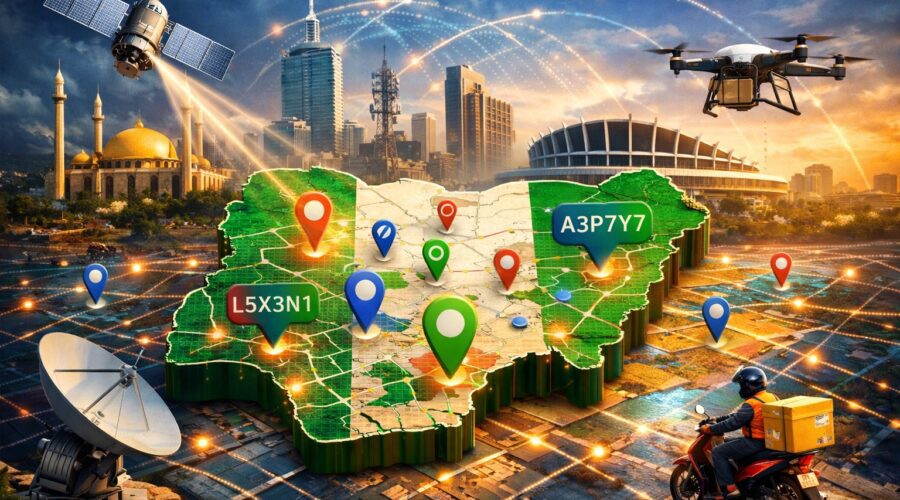
The recently authorised postcode system is based on geographic information system technology, or GIS-enabled. In simple terms it assigns distinct alphanumeric codes to locations throughout Nigeria using digital maps and geospatial intelligence.
This system will produce a distinct set of letters and numbers that are directly linked to geographic coordinates, unlike the old numerical postcode structure. This means that every location (homes, businesses, institutions, or public facilities) can have a precise digital address. The codes can be integrated into navigation systems, digital maps, logistics platforms, and government databases.
For example, instead of relying on directions like “third street after the market behind the petrol station”, a digital postcode can point directly to a mapped location on a digital platform.
E-commerce platforms will benefit from faster and more reliable deliveries. Logistics companies can optimise routes using accurate location data. Financial institutions can improve identity verification and compliance with Know-Your-Customer requirements
Furthermore, government organisations can use geospatial data from digital addresses to plan infrastructure projects more easily. This better addressing system will also help with tax administration, utility services, healthcare delivery, and disaster response.
Conclusion
Nigeria’s approval of a GIS-enabled alphanumeric digital postcode system is a major milestone. After years of effort and preparation, the government is finally on its way to establishing a unified addressing framework capable of precisely identifying every site across the nation.
However, the success of this initiative will be primarily determined by its implementation. Mapping the entire country, educating the public, and connecting the system with current platforms will necessitate ongoing effort and collaboration.
If successfully implemented, Nigeria’s digital postcode system has the potential to become one of the most important building blocks of the country’s digital economy, moving it closer to a future in which every person, home, and business can be easily located in the digital realm.

Related Posts

Lebara Nigeria Partners With India’s ‘Forever 7 Entertainment’ Launches ‘LebaraPlay’, Africa’s First Telecom-Owned Micro-Drama Platform
Lebara Nigeria shakes up Africa’s digital entertainment space with LebaraPlay the continent’s first telecom-owned micro-drama platform, blending Nollywood and Bollywood storytelling.
How French Tech Lagos 2.0 Is Quietly Rewriting the Rules of African Innovation
What happens when Europe’s most ambitious tech nation meets Africa’s most dynamic startup ecosystem? There’s…

Paystack’s ‘SME-Focused Growth Initiatives’ Roll Out $2,900 Support Package For Nigerian SMEs
Paystack launches a $2,900 SME support package, offering digital tools, grants, logistics, bookkeeping, and growth resources to help Nigerian businesses scale faster.

Africa Tech Festival 2026: Africa’s Biggest Technology Gathering To Host Over 400 World-Class Speakers
Africa Tech Festival 2026 returns to Cape Town with 400+ global speakers, AI innovation, cybersecurity insights, startup growth, and Africa’s digital future in focus.

Building Capacity and Stronger Business Ties: Franco-Nigerian Chamber Marks Milestone With Successful Inaugural Paris Leadership Training and Business Mission.
FNCCI concludes its first Paris Leadership Training Program, empowering Nigerian executives with global insights in AI, sustainability, investment, and international collaboration.