

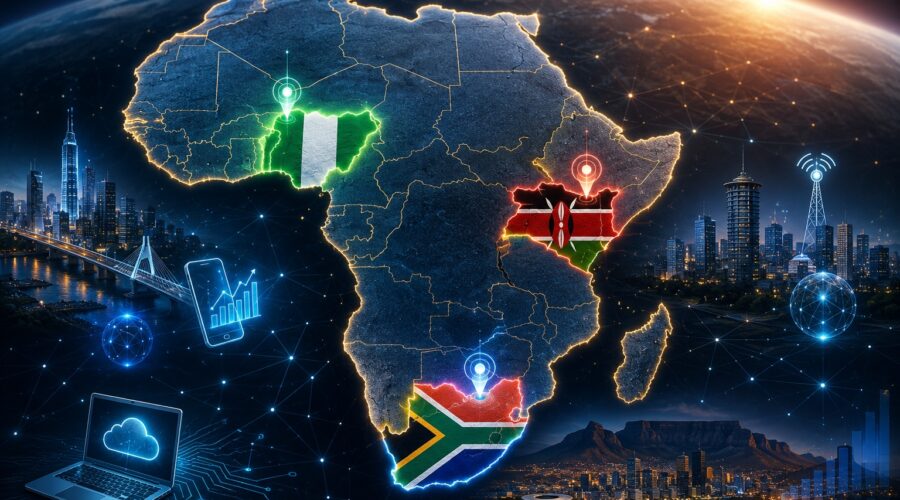
Unstoppable African Tech Giants 2026: Nigeria vs Kenya vs South Africa Innovation Showdown
A Fast-Growing Digital Revolution
The African technology scene in 2026 is undergoing a significant shift, being sprouted by fast digital adoption, financial disruption, artificial intelligence expansion, and aggressive startup ecosystem growth. When the three continental tech giants, Nigeria, Kenya, and South Africa, are compared, the results are a fascinating mix of explosive innovation, structural advantages, and deeply ingrained systemic issues.
This comparison tells a compelling story of rivalry, resilience, and digital domination across Africa’s most important tech hubs.
In 2026, Africa’s technology ecosystem is one of the most talked-about developing markets in the world, with terms like “African startup boom”, “fintech revolution Africa”, “AI adoption in Africa”, and “digital transformation Africa 2026” dominating worldwide search trends. Investors are increasingly lured to the continent because of its young population, mobile-first economy, and fast-rising internet access. However, the intensity and maturity of technological growth vary substantially by region, with Nigeria, Kenya, and South Africa serving as the major pillars of African innovation.
Nigeria: The Giant of Scale, Hustle, and Fintech Domination
In terms of population-driven scale and startup vigour, Nigeria is without a doubt the African tech heavyweight.
The Nigerian ecosystem thrives on high-pressure innovation, where necessity inspires invention and disruption is constant. Lagos is the beating core of this digital economy, dubbed Africa’s Silicon Valley due to its high concentration of startups, venture capital activity, and digital commerce platforms.

The Nigerian IT sector is heavily controlled by fintech titans and payment infrastructure innovation, with digital banking, mobile money alternatives, and cryptocurrency acceptance affecting daily transactions. Despite infrastructure issues, the country’s startup ecosystem is aggressive, fast-moving, and extremely competitive, consistently producing unicorns.
However, Nigeria’s strength comes with instability. Power supply unpredictability, regulatory uncertainty, and high operational costs continue to put a strain on startups. Nonetheless, the tenacity of Nigerian founders remains a defining characteristic, earning a reputation for daring, high-risk, high-reward innovation. The keywords “Nigeria fintech dominance”, “African startup capital hub,” and “Lagos tech ecosystem 2026” continue to rank high as a result of this explosive pace.
Kenya: The Innovation Lab of Mobile-First Africa

Kenya represents a more structured and innovative tech sector, known as the “Silicon Savannah”. It is well-known for pioneering mobile money systems, which altered financial inclusion throughout Africa.
Kenya’s tech environment is more stable and policy-friendly than many of its continental counterparts, positioning it as a strategic base for scalable digital solutions.
In 2026, Kenya remains at the forefront of mobile-first innovation, agritech solutions, and public-sector digital transformation. The country’s technological advancement is inextricably linked to real-world issue resolution, particularly in agriculture, logistics, and financial inclusion for rural communities. Nairobi continues to be a major magnet for foreign technology companies and impact investors looking for long-term African innovation.
Despite its capabilities, Kenya faces obstacles in growing firms to global unicorn status due to its smaller domestic market than Nigeria. However, its reputation for stability, innovative discipline, and government engagement places it among Africa’s most trusted locations for technological development.
South Africa Is The Continent’s Structured Technology Powerhouse.
South Africa is largely recognised as Africa’s most structurally advanced IT environment, thanks to improved infrastructure, sophisticated financial systems, and close connections with global markets. It is frequently the entrance point for international technology businesses expanding into Africa due to its regulatory expertise and business-friendly environment.

In 2026, South Africa’s digital landscape is distinguished by advanced enterprise solutions, artificial intelligence integration, cloud computing expansion, and robust fintech infrastructure. Cities such as Cape Town and Johannesburg act as innovation hubs for software engineering, cybersecurity, and enterprise SaaS development.
While South Africa may not have the same startup volume as Nigeria or Kenya in terms of mobile-first social innovation, it does excel in quality, scalability, and global integration. Its ecosystem is frequently defined with strong buzzwords such as “Africa’s enterprise tech hub”, “advanced digital infrastructure Africa”, and “AI-ready economy South Africa”.
However, difficulties such as unemployment, economic inequality, and slow grassroots startup expansion continue to have an impact on the country’s overall technological vitality.
The Fintech Wars
The fintech sector remains the most competitive in all three countries. Nigeria leads in transaction volume and consumer-facing innovation; Kenya leads in mobile money infrastructure and financial inclusion systems; and South Africa excels in regulated banking technology and enterprise financial systems.
This generates a strong continental balance, with Nigeria being aggressive and market-driven, Kenya being innovative and inclusive, and South Africa being structured and enterprise-orientated. Together, they will form the foundation of Africa’s digital financial revolution in 2026.
Venture capital flow in Africa remains concentrated around these three nations, with Nigeria receiving high-risk, high-reward investments, Kenya attracting impact-driven funding, and South Africa securing institutional and corporate venture capital.
Nigeria’s ecosystem is defined as chaotic yet lucrative, Kenya’s as stable and conducive to innovation, and South Africa’s as structured and globally aligned. This diversity makes Africa one of the world’s most active startup locations, even as global funding cycles shift.
Infrastructure, Connectivity and Digital Readiness

Infrastructure remains a key distinction. South Africa has the most stable power supply and internet infrastructure, followed by Kenya, which has strong mobile penetration and government-backed digital systems, while Nigeria continues to suffer with infrastructure gaps despite tremendous consumer demand and innovation.
This disparity influences how businesses operate, scale, and thrive in each country, compounding disparities in innovation cultures throughout the continent.
Artificial intelligence use is increasing in all three countries, albeit at different rates. South Africa is the leader in enterprise AI adoption and research integration, Kenya is focused on applied AI in agriculture and public services, and Nigeria is fast adopting AI through fintech, content development, and digital entrepreneurship.
Conclusion
The phrases “AI revolution Africa 2026”, “machine learning startups Nigeria, Kenya, South Africa”, and “digital intelligence Africa” indicate the rapid transformation of all three ecosystems.
The comparison of Nigeria, Kenya, and South Africa finds no clear winner, but rather three distinct models of technological superiority. Nigeria leads in scale, energy, and fintech disruption, making it Africa’s most aggressive innovation engine. Kenya excels at innovation, discipline, mobile-first solutions, and real-world effect, establishing itself as the continent’s most socially integrated digital hub. South Africa leads in structure, infrastructure, and global preparedness, giving it the continent’s most enterprise-ready ecosystem.
These three countries create a formidable triangle that will shape Africa’s digital destiny in 2026, driving growth, innovation, and transformation in the fintech, AI, and startup sectors. The future of African technology is collaborative in momentum, rather than competitive in isolation, and these three titans are leading the charge into a daring and extremely disruptive digital age.
Related Posts

Political Dynamics, Global Realignment: What Tola Adeyemi Told CEOs at FNCCI-KPMG Luncheon Series 6
As Nigeria heads toward the 2027 election, KPMG’s Tola Adeyemi urges businesses to prepare for multiple outcomes, policy shifts and new opportunities.
NITDA Builders Festival 2026: Smart Way to Unlock Startup Opportunities
NITDA Builders Festival 2026 offers Nigerian startups a path to ₦3bn in potential investment and pilot contracts by connecting real solutions with institutions.

Nigeria’s Internet Traffic: The Essential Growth Drivers Behind a 168% Surge
Nigeria’s internet traffic surged 168% in three years. Discover the key drivers behind the growth and what it means for businesses, SMEs and entrepreneurs.

Konga And Defence Headquarters Launch Nationwide Discount Scheme for Serving, Retired And Veteran Military Personnel
Konga and Defence Headquarters launch a nationwide discount scheme giving serving, retired and veteran military personnel access to essential goods at reduced prices.

Askya Offers African AI Startups Up To $200,000 In Investment Through New Growth Platform
Askya Investment Partners has launched a six-week AI Growth Platform for 10 African startups, offering zero-equity participation, business support and potential investment of up to $200,000