


Nigeria enters the global carbon markek, unlocks $3bn annually: How carbon credits will work, who benefits, and who pays
What really happened
Nigeria, the largest economy in Africa is making a daring entry into the global carbon market with the goal of turning climate action into genuine economic opportunity. This is more than just a press release.
Nigeria presented its Carbon Market Framework, a new policy framework that establishes the institutional and legal framework for carbon trading in the nation, at the ADSW 2026 in the United Arab Emirates. This could be one of the most significant policy changes in recent memory.
What in particular is a carbon market?
It helps to know the basics,in order to comprehend the shift:
Carbon markets are mechanisms that let emissions reductions be turned into financial instruments carbon credits, that can then be sold or traded..
For example:
- Climate-friendly projects (such as renewable energy, reforestation, clean cooking, climate-smart agriculture, and green infrastructure) can be financed and carried out by both domestic and foreign investors.
- The credits can then be sold to companies or countries that needs to offset their emmisions.
- While buyers use credits to fulfill their climate commitments, money flows into huge projects.
The goal of Nigeria’s new framework is to create this ecosystem at home and link it to international trade.
Within this framework:
The market will be managed by Nigeria’s climate policy coordinator, the National Council on Climate Change (NCCC).
Nigeria is now positioned as a major player in the global green economy, both as a market participant and a climate advocate. This is historic for a number of reasons:
Speaking to reporters in the United Arab Emirates on the fringes of Abu Dhabi Sustainability Week, Mrs. Omotenioye Majekodunmi, Director General of the National Council on Climate Change (NCCC), made this claim.
According to Mrs. Majekodunmi, the approval offers Nigeria a clear institutional and regulatory framework for carbon trading, allowing both domestic and foreign investors to create and fund environmentally friendly projects while receiving carbon credits.
The development, according to her, indicates that Nigeria is now completely open to climate-related business.
she said “With the final approvals in place, Nigeria is officially ready to do business. We are now positioned to begin seeing real returns. The carbon market alone is valued at over $3.8 billion in potential investments annually,”
The National Council on Climate Change, a Presidency-based organisation founded by the Climate Change Act of 2021, is in charge of the Carbon Market Framework. As per the Act, the Vice President is the Vice Chairman and the President is the Chairman of the Council.
The NCCC Director General claims that President Tinubu’s determination to make climate action a central component of his Renewed Hope Agenda is reflected in the approval.
Additionally, Mrs. Majekodunmi disclosed that Nigeria has already witnessed significant interest in carbon-related projects, emphasising that the Council has received between 3,000 and 4,000 applications since initial approvals were given in October.
She pointed out that the carbon market offers opportunities in a number of industries, such as clean cooking, reforestation, climate-smart agriculture, renewable energy, and sustainable infrastructure.
Nigeria’s attendance at Abu Dhabi Sustainability Week is a component of efforts to strengthen international ties, especially with the United Arab Emirates, according to the NCCC DG.
‘’We see a lot of potential for collaboration in renewable energy, sustainable finance, climate technology, and carbon markets. And as such, the Abu Dhabi Sustainability Week provides the right platform to be able to deepen this relationship and this partnership to get real impact,’’ she stated.
With plans to improve Nigeria’s capabilities in clean energy systems, agriculture, and climate-resilient infrastructure, Mrs. Majekodunmi continued, technology transfer, innovation, and local capacity development continue to be top priorities.
Conclusion
If carbon trading is successful, it has the potential to be more than just a source of income; it could serve as a catalyst for Nigeria’s green transformation by tying climate action to sustainable growth, job creation, and economic development.
Nigeria’s introduction of a carbon market in Abu Dhabi is an economic strategy rather than merely climate news. If this policy is implemented properly, it has the potential to drastically alter the nation’s climate finance future, with billions at stake and international attention.

Related Posts
Nigeria’s Naira Strengthens in 2026 as Economic Conditions Improve
Nigeria’s economy is rebounding in 2026! With reserves hitting $46B and inflation plunging, a stronger Naira is driving a 4.49% growth surge. See what’s next here.
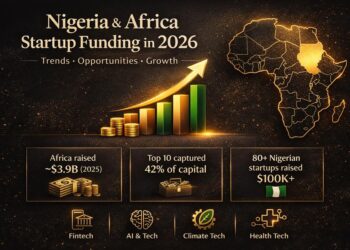
Nigeria and Africa Startup Funding in 2026: Trends, Opportunities, and Growth
In 2026, Africa’s startup scene is rebounding with disciplined growth. Led by Nigeria’s tech hubs, a shift toward sustainability and local VC is building a resilient, impact-driven future.

From Business to Wellness: Google Shows What Nigerians Want in 2026
Forget just planning—2026 is the year Nigerians take action! From digital startup surges to a massive wellness shift, see how a nation is reinventing itself online.

NextGen Innovation challenge 2026: National board for technology incubation pushes for global relevance
Innovation is no longer just a buzzword; it’s the driving force behind competitive economies, the…

2026 and the rise of digital taxation: Inside the 187% surge in tax revenues
While official data for actual tax income earned in 2026 are not yet available, analysts…