

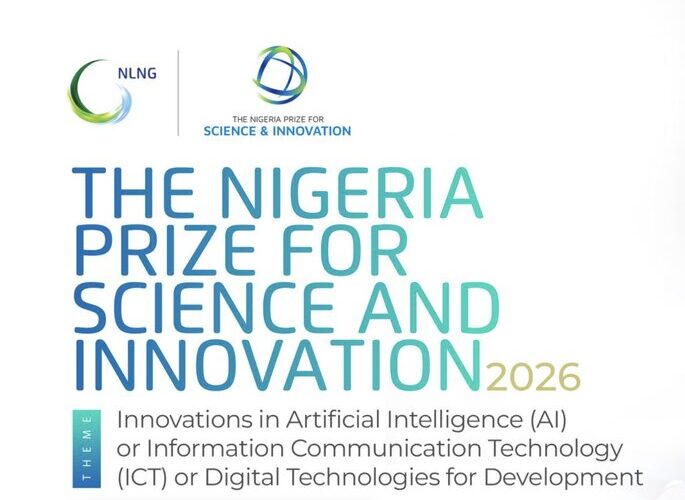
Nigeria Prize For Science And Innovation 2026 Breaks Record with 237 Entries; Winner Will Get $100,000
The 2026 edition of the prestigious Nigeria Prize for Science and Innovation, sponsored by Nigeria LNG Limited (NLNG), has officially recorded its highest-ever number of submissions since inception in 2004. With 237 entries submitted, the prize has reached an extraordinary peak that signals a powerful surge in scientific ambition across Nigeria.
According to official reports, the entries were formally handed over to the Prize Advisory Board in Lagos, marking the beginning of a rigorous adjudication process that will determine Nigeria’s most outstanding scientific and technological innovation of the year.
This record-breaking turnout has been described as both impressive and competitive, reinforcing the prize’s reputation as Africa’s most prestigious science award with a monetary value of $100,000 for the winning entry.
A Bold Theme
The 2026 edition is based on a timely and forward-thinking theme: “Innovations in Artificial Intelligence (AI) or Information Communication Technology (ICT) or Digital Technologies for Development.”
This theme represents Nigeria’s urgent need for digital transformation in a fast-changing global economy. Organisers emphasised that the focus is deliberate, strategic, and in line with the reality of the fourth industrial revolution, in which artificial intelligence, digital infrastructure, and emerging technologies shape national competitiveness.
NLNG officials have identified digital infrastructure as a “foundation for survival” in modern economies, emphasising that Nigeria must move beyond research talks to effective, scalable innovation that answers real-world challenges. The increase to 237 entries reflects increased confidence, intellectual maturity, and innovative thirst in Nigeria’s scientific community.
This trend signifies a huge moment in which more researchers, engineers, companies, and institutions are actively striving to address urgent national concerns such as digital inclusion, healthcare delivery, agricultural production, and smart infrastructure.
Despite the excitement, the organisers have maintained a firm stance that quality is still more important than quantity, sustaining the prize’s high standards of excellence.
The Strict Standards Behind The Prestige
The Nigeria Prize for Science and Innovation is not your usual prize. It is well-known for its tough examination procedure, stringent standards, and elite-level inspection.
The Advisory Board has continuously stated that only ideas that demonstrate originality, real-world effect and technical depth will be considered for the prize.
The handover kicks off the quest for Nigeria’s most innovative scientific mind, with the theme “Innovations in ICT, Artificial Intelligence (AI), and Digital Technologies for Development”. The theme was a planned carryover from the 2025 edition, which ended without a victor since no entries matched the selection criteria.
This mindset strengthens the prize’s reputation as a gold standard of scientific achievement, in which mediocrity is not rewarded and only breakthrough contributions make it through the review procedure.
Key Personalities Behind The Prize Have Issued Affirming Comments Emphasising Its Objective
Sophia Horsfall, NLNG‘s General Manager for External Relations and Sustainable Development, stated during the press conference that the continuous emphasis on digital technologies reflects both global trends and Nigeria’s development ambitions. She emphasised that the Prize continues to serve as a platform for recognising solutions with real-world impact.

“In this fourth revolution, digital infrastructure is as foundational to our survival as electricity or water. For Nigeria, our economic sustainability depends on our ability to move beyond promising research and into undeniable innovation that delivers.”
“We feel that if a Nigerian discovery is to command global recognition, it must survive the most rigorous scrutiny. This conviction drove the difficult decision seven months ago.”
Sophia Horsfall
While acknowledging the theme’s continued popularity, Horsfall stated that expectations remain unyielding, stating that only ideas proving actual effect and scalability will be considered. She further stated that the choice not to award a winner in 2025 reflects this commitment and establishes the standard for the present adjudication process.
Receiving the entries, Chairman of the Advisory Board Barth Nnaji described the transfer as a critical step in the Prize’s selection process, underlining that the Prize’s credibility is based on high standards of excellence. He underlined that the Prize’s mission remains to identify innovations that transfer scientific insight into meaningful socioeconomic effects.

“Our refusal to award the prize in 2025 was not a dismissal of the hard work of Nigerian innovators; rather, it reinforces that The Nigeria Prize for Science and Innovation holds a gold standard of excellence.”
Barth Nnaji
He went on to say that the conclusion of the 2025 edition, in which no winner was chosen, should be regarded in light of the Prize’s rigorous evaluation methodology, which requires uniqueness, depth, relevance, and verifiable impact. He emphasised that all entries would continue to be subjected to the same rigorous intellectual and technical evaluation.
Professor Nnaji further stated that the Prize seeks answers that directly address Nigeria’s real-world concerns.
“Our broader objective is to identify work that brings tangible impact to the challenges Nigeria faces, whether through digital health technologies that serve rural populations or the use of AI in preserving our cultural heritage and languages.”
The Board also includes Chief Dr Nike Akande, a two-time former Minister of Industry, and specialist Baba Yusuf Abubakar, a specialist in quantitative genetics and animal breeding.
Program Overview, Eligibility, Entry Requirements
The Nigeria Prize for Science and Innovation, now in its 22nd year, is worth $100,000 and remains undoubtedly Africa’s most renowned science prize. The winning submission for the 2026 edition will be announced at a global press conference in September.
Eligibility
The Award is open to: Scientists and innovators worldwide (both Nigerian and non-Nigerians)
Startups, practitioners, and interdisciplinary teams use science and innovation to address development concerns.
While members of the Advisory Board or Panel of Judges (during their service year and the next year), including their families, NLNG employees and their immediate family members (during duty and up to five years after service) are all ineligible.

Entry Requirements
Submissions must
- Show clear integration of AI, ICT, or digital technologies.
- Demonstrate practical application and operational clarity.
- Provide proof of deployment, piloting, or real-world testing.
- Present quantifiable or well-described societal impact.
- Describe scalability, sustainability, and adoption possibilities.
The entry should be - A finished scientific work or new technology, backed by proof of concept or demonstrable impact.
- Submitted as a single entry (only one per person or team).
- Accompanied by all necessary supporting materials before the deadline
Collaborative works involving two or more people are authorised. The prize is granted solely on the basis of brilliance and demonstrable impact.
Submission Process
- The applicants must: Visit the official webpage https://www.thenigeriaprizes.org
- Navigate to the Application Forms area.
- Select Science – Call for Entries.
- Download and fill out the application form.
- Upload all essential documents as instructed.
Challenges and Criticism
While the 2026 milestone is widely regarded as positive, the prize is also notorious for its unusually high rejection rate, which some opponents believe reflects the difficulties of reaching its standards.
The fact that no winner emerged in previous editions has spurred debate over whether the criteria are excessively strict or whether Nigeria’s innovation ecosystem requires additional structural support.
However, supporters say that the strictness is required to encourage Nigerian innovators to focus on global competitiveness, precision, and world-class standards rather than just local recognition. This momentum is particularly crucial as Nigeria positions itself in global discussions about AI, digital transformation, and knowledge-based economies.
Conclusion
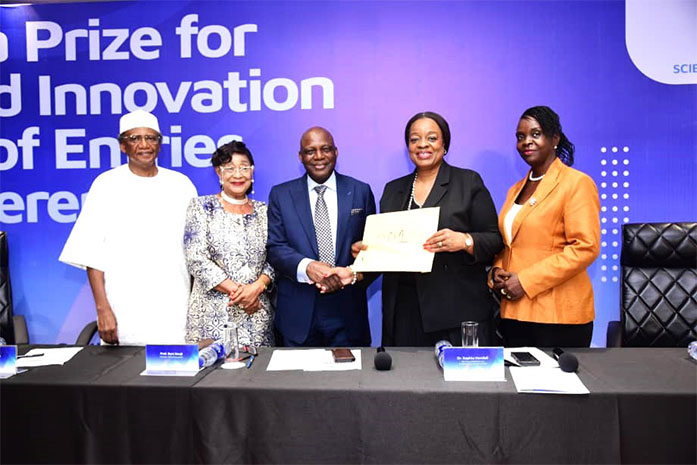
The 2026 Nigeria Prize for Science and Innovation received 237 entries, setting a new record for participation and ambition. This development represents a surge of innovation, drive, and intellectual strength in Nigeria’s scientific community.
While the competition is still extremely hard and selective, it is precisely this rigour that increases the prize’s prestige and ensures that only the most significant breakthroughs are recognised.
Finally, the 2026 edition represents a tremendous symbol of progress, hope, and transformation, demonstrating that Nigeria’s innovation ecosystem is not only expanding but also moving toward global greatness.
Related Posts

Political Dynamics, Global Realignment: What Tola Adeyemi Told CEOs at FNCCI-KPMG Luncheon Series 6
As Nigeria heads toward the 2027 election, KPMG’s Tola Adeyemi urges businesses to prepare for multiple outcomes, policy shifts and new opportunities.
NITDA Builders Festival 2026: Smart Way to Unlock Startup Opportunities
NITDA Builders Festival 2026 offers Nigerian startups a path to ₦3bn in potential investment and pilot contracts by connecting real solutions with institutions.

Nigeria’s Internet Traffic: The Essential Growth Drivers Behind a 168% Surge
Nigeria’s internet traffic surged 168% in three years. Discover the key drivers behind the growth and what it means for businesses, SMEs and entrepreneurs.

Konga And Defence Headquarters Launch Nationwide Discount Scheme for Serving, Retired And Veteran Military Personnel
Konga and Defence Headquarters launch a nationwide discount scheme giving serving, retired and veteran military personnel access to essential goods at reduced prices.

Askya Offers African AI Startups Up To $200,000 In Investment Through New Growth Platform
Askya Investment Partners has launched a six-week AI Growth Platform for 10 African startups, offering zero-equity participation, business support and potential investment of up to $200,000