

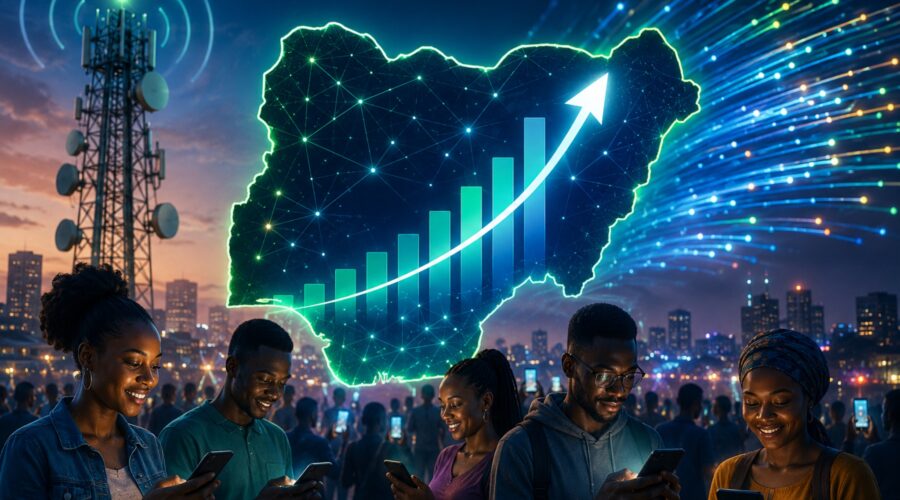
4bn Gigabytes in Q1 2026: Record-Breaking Internet Usage In Nigeria
Record-Breaking Surge: A New Digital Peak
Nigeria’s internet economy has entered a revolutionary, high-speed era, and the figures are nothing short of astounding. According to figures from the Nigerian Communications Commission, the country utilised over 4.06 million terabytes of data in the first quarter of 2026, which is equivalent to more than 4 billion gigabytes in 90 days, a historic, record-breaking increase.
The Q1 2026 figure of 4.06 million terabytes exceeds the previous high of 3.86 million terabytes achieved in late 2025, indicating a steadily growing trend. March alone saw a stunning peak of 1.42 million terabytes utilised in a single month, the biggest ever recorded. This growth represents a fundamental behavioural shift, with Nigerians spending more time online, consuming better information, and relying on digital platforms for daily life.
In March alone, internet subscribers increased by more than 650,000 to 153.82 million, primarily due to mobile connections. The total number of telecom consumers in the country presently stands at 185.7 million.
According to Marque Projections, a digital media and branding company in Lagos Nigeria, data has effectively become the new oil that drives the economy, a statement that is increasingly being heard in telecom debates.
Between January and March 2026, Nigerians spent almost ₦3.33 trillion on data, demonstrating the economic importance of connection. This underlines a startling reality: whomever controls connectivity increasingly influences economic consequences.
Mobile-First Nation
Nigeria’s digital economy remains mobile-first, with smartphones serving as the primary mode of access. With more than 150 million internet users, mobile data dominates access and consumption trends. Smartphones and internet plans have become more affordable, allowing millions of people to participate in the digital economy, right there from e-commerce to content creation.
And also behind this boom is a vast, capital-intensive infrastructure expansion. Providing over 4 million terabytes of data necessitates a complex ecosystem of subsea cables, fibre optic networks, and over 20,000 telecom towers operating at scale. Major telecom companies have aggressively invested billions of naira in network upgrades, signalling a high-stakes contest for digital dominance.
Moving such vast amounts of data necessitates extensive network capacity. Nigerian telecom carriers have responded with significant spending. MTN Nigeria, the market leader, spent over N1 trillion (nearly $727 million) on network upgrades last year.
Airtel invested hundreds of millions of dollars, while Globacom increased its fibre reach. These investments underpin a massive system of subsea cables, countrywide fibre optic lines, and over 20,000 high-capacity telecom towers.
Aminu Maida, the NCC’s executive vice chairman, announced that more than $1 billion will be invested in telecom infrastructure this year, outpacing overall industry investment the previous year. Older 2G and 3G networks continued to lose ground in the first quarter, with 36.75 percent and 5.30 percent of connections, respectively.
In comparison, 4G presently accounts for 53.79 percent of total connections, a tiny increase from February. 5G, which is still in its early phases, has a 4.2 percent share but is seeing an increase in heavy data traffic in areas such as Lagos and Abuja.
Maida admitted that 5G deployment remains slower than 4G but regarded it as a logical progression. Like earlier technologies, 5G adoption is limited by device availability, pricing, and infrastructure maturity.
He added that 5G has yet to equal the magnitude and maturity of 4G, and Nigeria is no exception. However, he expressed confidence that adoption will go up over time as enabling conditions improve. Maida stated that the sector is only now recovering from a long period of underinvestment, which has resulted in the congestion and service gaps that Nigerians face today. According to him, the scope of current infrastructure expansion indicates a tipping point.
While operators deployed just over 300 new or improved sites last year, the sector has committed to around 12,000 site upgrades by 2026 alone. Approximately 2,800 upgrades have already been performed, including new sites, capacity expansion, and the migration from older 2G and 3G infrastructure to more efficient 4G and emerging 5G networks. This, he noted, puts the industry well ahead of last year’s pace and reflects restored investor confidence.
He stated that gains in quality of service are already being seen in important measures such as data speeds; however, difficulties like latency remain. The Commission’s constant monitoring, backed up by quarterly performance reports, reveals that, while the trend is favourable, the user experience remains unequal and requires sustained work.
The intentional expansion and redistribution of spectrum resources, according to the NCC CEO, has been a primary driver of recent advances. Spectrum trade and reallocation have made around 100 MHz of formerly underutilised spectrum available to operators. This has effectively expanded the “digital highways” that carry telecom traffic, increasing coverage and speed.
He pointed out that different spectrum bands serve different functions; lower frequencies enable rural coverage, whereas higher bands increase capacity in heavily populated urban regions. The new spectrum assignments have allowed operators to upgrade networks more effectively, resulting in substantial improvements in data performance, notably in the first quarter of the year.
The EVC emphasised that these investments must be in addition to previously budgeted capital expenditures for 2026 and not a reallocation of existing resources.
To maintain compliance, independent auditors will verify all declared investments, discouraging operators from diverting cash or falsifying expenses. He emphasised that this approach supports the Commission’s overall policy of returning value to consumers and enhancing network capacity rather than enforcing merely financial sanctions.
What’s Driving the Massive Data Consumption Boom?
The increase in data consumption is being driven by a tremendous convergence of digital forces. Streaming platforms, high-definition video content, AI-powered technologies, and social media ecosystems are all a big part of this intense development and never-ending interaction.
Activities ranging from entertainment to productivity, Nigerians are using more data-intensive services than ever before. A typical user now consumes over 28GB over three months, indicating a trend toward richer, more engaging digital experiences. AI tools, remote work platforms, and cloud-based applications are rousing this desire, transforming the internet into what many refer to as “the new office”.
The data boom sends significant economic signals. Increased internet usage benefits digital commerce, fintech, and the broader digital economy, which many experts regard as a critical economic engine for Africa’s most populous country.
For now, the record quarter emphasises both progress and pressure. Total data consumption for 2025 has already reached roughly 13.2 million gigabytes, according to previous NCC numbers, indicating that the increasing trend has been developing for some time.
With March’s robust growth, experts estimate full-year 2026 figures to establish a new milestone, if infrastructure keeps up with demand.
A Positive Signals: Growth, Innovation, And Opportunity
The growth in data consumption provides strong, positive indicators for Nigeria’s future. It represents increased internet penetration and a rapidly growing digital user base. It represents a dynamic, innovation-driven ecosystem in which entrepreneurs, creators, and enterprises can thrive.
It also opens up enormous prospects for cloud computing, AI platforms, streaming services, and digital banking solutions. Perhaps most crucially, it establishes Nigeria as a dominating digital powerhouse in Africa, with the potential to attract global tech investment and alliances.
Despite increased usage, network quality remains unpredictable, with common complaints of poor speeds and unreliable connections. Infrastructure strain is becoming a serious concern as networks struggle to meet increasing demand. Fibre cuts, power outages, and vandalism continue to impede service delivery.
There is also a growing digital gap, with cities benefiting from speedier networks while rural areas lag behind. Simply put, development is spectacular but unequal, and without purposeful intervention, it may become unsustainable.
Albeit, what we are seeing is more than just greater consumption; it is a cultural and behavioural shift. The internet is no longer an option. It is ingrained in everyday life. Students learn online, businesses sell online, drivers navigate online, and creators establish jobs online. As one view puts it, “The internet is the new language”, and individuals who lack access risk being excluded from modern economic engagement.
Telecom businesses will evolve into essential economic enablers, rather than just service providers. At the same time, regulators and legislators will be under growing pressure to enhance infrastructure, assure fair pricing, and broaden access to disadvantaged areas.
Conclusion
Nigeria’s 4 million terabyte data milestone recounts a story of quick adoption, uncontrollable demand, and enormous possibility, as well as infrastructure stress, inequality, and the critical need for innovation.
The direction is clear: Nigeria is emerging as one of the world’s most important digital economies. The fundamental question isn’t whether growth will continue; it will. The question is whether the country can scale sustainably, equitably, and smartly to fully capitalise on this enormous digital revolution.
Related Posts

Political Dynamics, Global Realignment: What Tola Adeyemi Told CEOs at FNCCI-KPMG Luncheon Series 6
As Nigeria heads toward the 2027 election, KPMG’s Tola Adeyemi urges businesses to prepare for multiple outcomes, policy shifts and new opportunities.
NITDA Builders Festival 2026: Smart Way to Unlock Startup Opportunities
NITDA Builders Festival 2026 offers Nigerian startups a path to ₦3bn in potential investment and pilot contracts by connecting real solutions with institutions.

Nigeria’s Internet Traffic: The Essential Growth Drivers Behind a 168% Surge
Nigeria’s internet traffic surged 168% in three years. Discover the key drivers behind the growth and what it means for businesses, SMEs and entrepreneurs.

Konga And Defence Headquarters Launch Nationwide Discount Scheme for Serving, Retired And Veteran Military Personnel
Konga and Defence Headquarters launch a nationwide discount scheme giving serving, retired and veteran military personnel access to essential goods at reduced prices.

Askya Offers African AI Startups Up To $200,000 In Investment Through New Growth Platform
Askya Investment Partners has launched a six-week AI Growth Platform for 10 African startups, offering zero-equity participation, business support and potential investment of up to $200,000