

NGCL Targets SME Growth with Exclusive ISO Certification Pathway
How Nigeria’s Small Businesses Can Unlock Bigger Contracts, Exports and Global Opportunities
The newly introduced certification pathway looks to address these long-standing issues while also assisting Nigerian SMEs to become more competitive both locally and globally. The launch of the NGCL Certification Pathway, a new initiative designed to make internationally accredited ISO certification more affordable, transparent, and accessible, has provided Nigeria’s small and medium-sized enterprises (SMEs) with what many industry stakeholders describe as a game-changing opportunity.
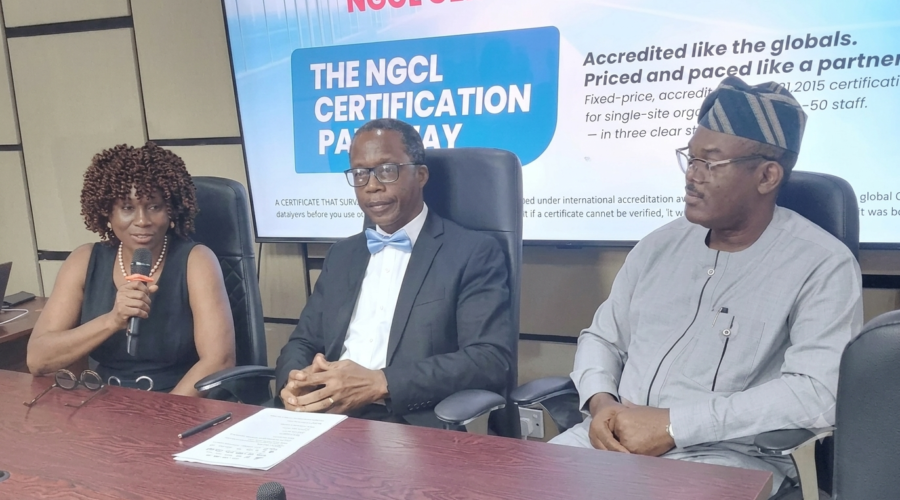
The initiative, announced by NECA‘s Global Certification Limited (NGCL) in Lagos, aims to remove one of the most significant impediments to Nigerian businesses competing for high-value contracts, government procurement opportunities, multinational supply chains, and export markets.
The NGCL Certification Pathway: Why Is ISO Certification Is More Important?
The NGCL Certification Pathway is a structured certification programme developed by NECA’s Global Certification Limited, a globally recognised management systems certification body based in Nigeria.
Rather than requiring businesses to navigate complex certification procedures on their own, the pathway offers a simplified, fixed-cost route to internationally accredited ISO 9001:2015 Quality Management System Certification. The programme was specifically designed for Nigerian businesses with 10 to 50 employees, making it one of the few certification programmes created with SMEs in mind.
Unlike traditional certification models, which frequently fluctuate due to consultants, auditors, or foreign exchange rates, the NGCL pathway provides predictable pricing and a clearly defined certification journey that businesses can understand before committing any funds.
Business standards are rapidly changing in Nigeria and throughout Africa. Large corporations, multinational corporations, development agencies, and government institutions are increasingly requiring suppliers to demonstrate internationally recognised quality management systems before awarding contracts.
This trend has accelerated further under the African Continental Free Trade Area (AfCFTA), which requires businesses exporting goods or services across African borders to meet internationally recognised quality standards.
Many Nigerian businesses are excluded from lucrative opportunities due to a lack of ISO certification, despite having high-quality products and capable employees. As a result, the certification is more than just a document; it also serves as proof that a company follows globally accepted quality management principles.
The Problem NGCL Wants To Solve
For many years, thousands of Nigerian SMEs have been unable to obtain ISO certification. Several factors have contributed to this unfortunate situation.
Many business owners thought certification was too expensive; others complained about pricing structures that lacked transparency. Some certification processes even last months and had unclear timelines. But, perhaps more concerning, has been the emergence of fraudulent certification providers who issue certificates that cannot be verified internationally.
These fraudulent certificates have led many businesses to believe they were certified, only to discover later that multinational clients and foreign partners rejected their documentation during due diligence exercises. The result has been missed contracts, damaged credibility, financial losses and reduced confidence in certification programmes generally. NGCL claims that its new pathway was designed specifically to eliminate these painful obstacles.
Edokpolo cautioned that many businesses unknowingly obtained certificates from unaccredited organisations, believing they had achieved international certification. Unfortunately, many later discovered that these certificates did not pass verification when presented to clients or procurement agencies.
He emphasised that internationally accredited certification includes independent verification, which is a critical feature lacking in many fake certificates on the market. The warning emphasises an important lesson for SMEs: certification should never be based solely on price, but rather on international accreditation and credibility.
What NGCL Officials Said At The Launch
During the unveiling in Ikeja, Lagos, NGCL’s Acting Managing Director, Noruwa Edokpolo, explained the motivation for the initiative.
“Our mission is to certify compliance with standards and remove trade barriers. For too long, the businesses that most need the doors of certification to be opened, such as corporate contracts and export markets, among others, have been the least able to access them.”
“The pathway changes that. It is accredited to the global standard and priced and paced like a partner. A business owner can now see the full journey, the full commitment, and the exact standard of service before spending a single naira.
So, we are specifically taking one of the standards, ISO 9001, and creating a product from it. That product is addressing the needs of small and medium-sized organisations.”
Noruwa Edokpolo

Those words show the initiative’s strongest selling point: increased transparency throughout the certification process.
Why NGCL Chose ISO 9001 And How Does The Certification Process Works
Despite the fact that numerous ISO standards exist around the world, NGCL chose to launch its first SME-focused programme around ISO 9001 Quality Management Systems. According to Edokpolo, ISO 9001 has one of the clearest and most standardised audit processes, making it ideal for smaller businesses starting their certification journey.
He explained that other ISO standards have higher technical complexity, which may make adoption more difficult for many SMEs. By focusing on ISO 9001 first, NGCL hopes to simplify implementation while allowing businesses to develop stronger management systems before expanding into other certifications in the future.
The NGCL Certification Pathway is a three-stage process that starts with readiness assessment and progresses to formal certification and ongoing surveillance audits.
Businesses that successfully complete certification will receive an internationally accredited ISO 9001 certification that is valid for three years. During this time, annual surveillance audits are performed to ensure that businesses continue to meet quality management requirements.
Businesses must undergo recertification audits at the end of each certification cycle in order to maintain their certified status. This approach promotes continuous improvement over one-time compliance. The most promising aspect of the NGCL initiative is the potential for new business opportunities. ISO certification is frequently required when bidding on multinational contracts, participating in government procurement, supplying large corporations, or entering export markets.
Businesses that previously considered these opportunities inaccessible may now have a realistic path to meeting international quality standards. Under the AfCFTA framework, certification is becoming increasingly important as African businesses compete across borders.
Organisations that can demonstrate internationally recognised standards typically enjoy increased buyer confidence, credibility, and market access.
Edokpolo explained on the choice of ISO 9001: it is the only standard with a clearly defined audit process.
“This product is only for the ISO 9001 Quality Management System. We have other standards, but ISO 9001 is the only one that is clear in terms of the audit process. The other standards have a bit more complexity, and that’s why we are not bringing them under this particular package.” – Noruwa Edokpolo
He added that the platform has put measures in place to ensure that the pathway serves only companies that are properly registered in Nigeria.
“The certification is for a duration of three years, and at the end of the three years, there will be a certification audit. So, it is actually an ongoing process.” – Noruwa Edokpolo
Conclusion
Despite the excitement surrounding the initiative, certification does not ensure business success. SMEs must continue to develop effective quality management systems, train employees, maintain proper documentation, and consistently comply with ISO standards. Before becoming certification-ready, some smaller businesses may require additional support in the form of consulting, capacity building, or financial assistance.
Furthermore, ongoing awareness campaigns will be required to educate entrepreneurs about the dangers of fraudulent certification providers and the importance of using accredited certification bodies.
The initiative promotes greater transparency, predictable pricing, and a structured certification journey, assisting businesses in avoiding the costly trap of fake certification providers. More importantly, it aligns Nigerian SMEs with rising quality expectations from government agencies, corporate supply chains, and the African Continental Free Trade Area.
Although certification is not a replacement for strong business management, it is becoming an increasingly important passport to success in today’s competitive market. The NGCL Certification Pathway could be a powerful stepping stone toward long-term business success and international competitiveness for ambitious Nigerian entrepreneurs seeking to expand beyond local markets, boost customer confidence, and open up new commercial opportunities.
Finally, the long-term success of the NGCL Certification Pathway is dependent on widespread adoption, consistent implementation, and continued trust in internationally recognised standards.
Follow Amebopreneur for the latest on Nigeria’s tech ecosystem, startup funding opportunities, and the cross-border partnerships shaping Africa’s innovation future.
Related Posts
Marque Technologies: Building World-Class Solutions And Changing The Rules Of Digital Innovation In Africa
Marque Technologies is helping Nigerian businesses grow through AI, enterprise software, NFC digital identity, and smart digital solutions built for Africa.