

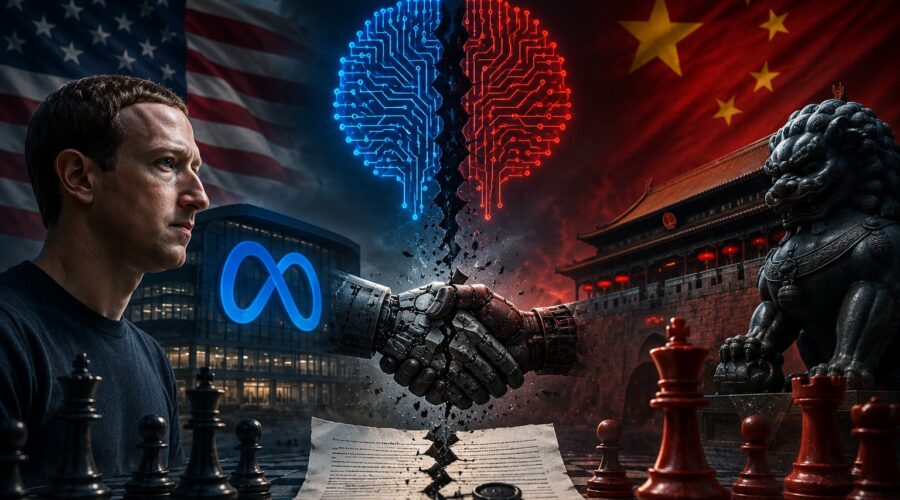
AI Is Now a National Security Weapon: China Forced Meta to Unwind a $2 Billion Meta-Manus AI Deal
The AI Cold War Has Entered a Dangerous New Phase
Artificial intelligence is no longer viewed solely as a technical industry, business opportunity, or startup gold rush. In 2026, AI has officially entered the realms of national security, geopolitical power, and strategic state dominance.

The most recent and possibly most alarming example is China’s involvement in Meta’s acquisition of Manus, a Chinese-founded AI business.
What looked to be a groundbreaking $2 billion acquisition by Mark Zuckerberg’s Meta has evolved into a striking emblem of how countries are increasingly viewing artificial intelligence as a strategic asset on par with modern weapons systems, nuclear technology, and military intelligence.
China’s National Development and Reform Commission (NDRC) issued a security review decision on April 27, 2026, prohibiting foreign investment in the Manus project and requiring the parties to cancel the contract. The statement is brief, but the message is loud.
Earlier this year, China’s Ministry of Commerce stated that it will review the deal’s compliance with rules governing technology import and export, export controls, outbound investment, and cross-border data exchanges. That is significant because it indicates that the examination considered not only who owns what, but also how technology and data might migrate across borders.
Manus garnered attention because it promotes a general-purpose AI agent capable of performing complicated tasks such as coding and market research, and it publicly claimed to have generated $100 million in yearly recurring revenue within months of its introduction. Meta’s wager was straightforward: AI agents will be the next significant platform layer.
What Exactly Happened?
Meta announced the acquisition of Manus in late 2025 in a deal allegedly worth around $2 billion. Manus quickly earned notice in the AI market for its superior autonomous AI agent technology, which can do complicated tasks with minimal human intervention. The company was regarded as one of the most promising participants in the growing AI agent sector.
At first appearance, the acquisition appeared uncomplicated. Manus had relocated its headquarters and major operations to Singapore, leading many observers to believe the corporation was outside the direct jurisdiction of Chinese regulators. However, Chinese authorities saw things differently.
Despite the migration, Beijing maintained that Manus remained a Chinese-origin technology company formed by Chinese engineers and hence fell within China’s national security assessment systems. Months after the acquisition agreement was finalised, China’s powerful National Development and Reform Commission (NDRC) initiated a review of the transaction.
China prohibited the deal and ordered both firms to cancel it entirely. Regulators reportedly ordered that Meta terminate the agreement, separate integrated activities, and stop sharing data between the two organisations.
The Founders Were Reportedly Restricted From Leaving China
One of the most contentious aspects of the lawsuit concerned Manus co-founders Xiao Hong and Ji Yichao.
According to reports, Chinese authorities summoned both founders to question them about potential foreign investment and technology transfer risks related to the Meta acquisition.
Following the sessions, Chinese regulators reportedly placed limitations that prevented them from leaving the country while the review was ongoing.

For many years, technological mergers and acquisitions were driven primarily by business considerations. Market dynamics dictated how companies were acquired, integrated, and absorbed. However, the Manus case demonstrates a new reality in which governments can interfere directly when important technology appears to be leaving national control.
Why China Blocked the Deal?
The official explanation focused on national security considerations.
Chinese regulators were reportedly concerned about the transfer of advanced AI capabilities, intellectual property, engineering experience, and significant technological assets to a major American technology company. Beijing has become more defensive of its domestic AI ecosystem as China and the United States compete for AI supremacy.
The decision illustrates the rising awareness among politicians that artificial intelligence is more than just software. Instead, it is increasingly regarded as crucial infrastructure capable of impacting military strength, economic competitiveness, cybersecurity, intelligence collection, and national sovereignty.
One of the most compelling conclusions arising from the case is that AI skill has become a strategic advantage. Governments no longer focus solely on technological exports. They are also concerned about the transfer of researchers, founders, engineers, and proprietary knowledge across borders.

What makes this story stand out is that the transaction had advanced far beyond the announcement stage.
According to reports, Manus workers had already joined Meta’s operations, technology integration had begun, and data-sharing agreements had been established before Chinese authorities ordered the company to reverse direction. According to reports, some investors have already received acquisition funds from the sale.
Meta apparently responded by disconnecting Manus from internal systems, limiting data sharing, prohibiting staff from accessing Manus tools, and initiating the operational separation mandated by Chinese authorities. For technology attorneys and M&A experts, the case has become one of the most noteworthy examples of a government forcing the cancellation of a successful AI acquisition.
The Meta-Manus Issue Is A Reflection Of A Much Wider Worldwide Trend
Governments around the world are increasingly treating artificial intelligence as a strategic technology, alongside semiconductors, defence systems, telecommunications infrastructure, and advanced manufacturing.
The US has placed limitations on sophisticated chip exports to China. China has strengthened controls over AI technologies, data transfers, and foreign investments. European lawmakers are enacting comprehensive AI legislation. Governments around the world recognise that whomever controls the most advanced AI systems will have significant economic and geopolitical benefits.
This has resulted in what many experts now refer to as the AI Cold War. Unlike previous conflicts, this competition is not fought with tanks or missiles. Instead, it focuses on algorithms, processing power, talent acquisition, intellectual property, and control over next-generation technology.
Supporters of China’s actions believe that the decision safeguards domestic innovation, avoids the loss of important intellectual property, and ensures that critical technology stays subject to national scrutiny. Advocates also argue that every major power is gradually imposing similar safeguards. They see China’s moves as a legitimate response to a more competitive global technology landscape.
Conclusion
A key element emerging from the dispute is what some experts refer to as “Singapore-washing”. For several years, Many Chinese entrepreneurs facing geopolitical uncertainty have shifted their headquarters to jurisdictions such as Singapore while maintaining close ties to Chinese founders, talent pools, and technology ecosystems.
The premise was that offshore incorporation would provide for greater flexibility in raising foreign funds and completing international transactions.
China’s actions send a strong signal that just transferring a corporation abroad may not be enough to avoid Chinese regulatory monitoring if officials believe important national interests are still involved. Beijing’s viewpoint implies that the origin of the technology, the founders, and the underlying intellectual property may be more important than the site of corporation registration.

As the race for artificial intelligence dominance heats up, national security considerations outweigh corporate objectives, investor expectations, and even finalised merger agreements. The message from Beijing is clear: in the age of artificial intelligence, strategic technology is more than just business. It is power.
Finally, readers should keep in mind that AI policy is no longer just about chips, models, and market dominance; it is also about land, power plants, water rights, and the environmental trade-offs associated with rapidly developing strategic infrastructure.
The formal announcement was released by China’s National Development and Reform Commission.
Related Posts
Political Dynamics, Global Realignment: What Tola Adeyemi Told CEOs at FNCCI-KPMG Luncheon Series 6
As Nigeria heads toward the 2027 election, KPMG’s Tola Adeyemi urges businesses to prepare for multiple outcomes, policy shifts and new opportunities.
NITDA Builders Festival 2026: Smart Way to Unlock Startup Opportunities
NITDA Builders Festival 2026 offers Nigerian startups a path to ₦3bn in potential investment and pilot contracts by connecting real solutions with institutions.

Nigeria’s Internet Traffic: The Essential Growth Drivers Behind a 168% Surge
Nigeria’s internet traffic surged 168% in three years. Discover the key drivers behind the growth and what it means for businesses, SMEs and entrepreneurs.

Konga And Defence Headquarters Launch Nationwide Discount Scheme for Serving, Retired And Veteran Military Personnel
Konga and Defence Headquarters launch a nationwide discount scheme giving serving, retired and veteran military personnel access to essential goods at reduced prices.

Askya Offers African AI Startups Up To $200,000 In Investment Through New Growth Platform
Askya Investment Partners has launched a six-week AI Growth Platform for 10 African startups, offering zero-equity participation, business support and potential investment of up to $200,000