

Economics of an Election Year: What 2027 Means for Nigeria’s Markets and Businesses
Explore how Nigeria’s 2027 elections could influence capital flows, stock market performance, investor confidence, business decisions and economic stability.
Nigeria is heading into another election cycle with a stronger macroeconomic foundation than in recent years, yet a familiar question has returned: can the country protect its economic gains from the pressures of political competition?
Inflation has moderated, foreign exchange conditions have improved, and capital has begun flowing back into Nigerian financial assets. At the same time, public debt remains high, long-term productive investment is still weak relative to portfolio inflows, and businesses continue to operate under structural constraints. The approach of the 2027 elections adds a layer of uncertainty that investors and policymakers cannot ignore.
Understanding the economics of an election year on how political competition affects capital flows, business decisions and macroeconomic stability is now essential for anyone watching Nigeria’s recovery. Political continuity is valuable, but institutional continuity is what ultimately sustains investment. Investors may prefer a particular administration’s policies, but they ultimately need confidence that the rules governing their investments will not change arbitrarily after an election.
Evidence from Nigeria’s Capital Markets
Research has long linked political uncertainty to movements in Nigeria’s financial markets. A 2022 study published in the International Journal of Business and Emerging Markets, titled Electoral Uncertainty and the Volatility of International Capital Flows in Nigeria, examined the relationship between political events and international capital movements.
Using structural vector autoregression and Granger causality tests, the researchers found that political shocks had adverse implications for the exchange rate and were associated with higher treasury-bill yields.
Interestingly, the study also found that attractive yields could outweigh political uncertainty in drawing investors to Nigerian financial markets. This distinction is important.
Political uncertainty does not automatically stop capital from entering Nigeria. It can, however, change the type of capital that arrives, its cost, and its investment horizon.
Portfolio Investment Dominates the Recovery
The difference between portfolio investment and foreign direct investment makes this particularly relevant.
| Capital Flow Type | 2025 Value | Share of Total |
| Total Capital Inflows | $23.22 billion | 100% |
| Foreign Portfolio Investment | $19.74 billion | ~85% |
| Foreign Direct Investment | $923 million | ~4% |
International investors showed strong interest in high-yield money-market instruments and bonds. The recovery in longer-term productive investment was far less pronounced.
Although the recovery in capital inflows is encouraging, its composition raises an important question about the quality and durability of the recovery.
Portfolio investment can provide liquidity to financial markets and support government financing, but it does not necessarily translate into new factories, productive capacity, technology transfer or employment. Nigeria must therefore look beyond the volume of capital entering the country and pay closer attention to the economic value that capital creates.
That distinction matters as the country approaches another election. Portfolio investors can adjust their positions relatively quickly.

Investors in manufacturing, energy, infrastructure and other long-horizon projects carry much greater exposure to policy continuity and the overall investment climate.
Nigeria’s challenge is not simply to attract capital ahead of the 2027 elections. It is to convince investors that the economic framework supporting their investments will remain credible after the elections.
What Is Happening in the Nigerian Stock Market?
A November 2026 analysis by Proshare compared the Nigerian Exchange’s performance ahead of the last three general elections with its performance ahead of the January 2027 election.
There is another side to this picture. Foreign investors accounted for only 10.1 percent of NGX turnover in the 12 months to September 2026, compared with 56.6 percent ahead of 2015, 54.2 percent ahead of 2019, and 16.7 percent ahead of 2023. Foreign investors were net sellers of approximately ₦262.8 billion during that 12-month period.
| Election Cycle | Real Change in NGX All-Share Index (Inflation-Adjusted) |
| Ahead of 2015 | –19.9% |
| Ahead of 2019 | –24.1% |
| Ahead of 2023 | –11.8% |
| Ahead of 2027 | +64.3% |
A stronger stock market does not automatically mean foreign investors have become less concerned about political risk. The composition of market participation matters. A market can rise on the back of domestic institutional activity, local liquidity and corporate earnings even while some international investors reduce exposure.
The divergence between market performance and foreign investor participation also raises questions about the depth of the current rally. A market increasingly supported by domestic participation can demonstrate growing local investment capacity, but it must also develop sufficient liquidity, institutional depth and international accessibility to sustain long-term expansion. The real questions are who is buying, why they are buying, and how long they intend to stay invested.
The Financial Cost of Electioneering
Elections are expensive, and Nigeria’s election expenditure has grown substantially. There are two distinct categories: public election expenditure managed by INEC, and political campaign expenditure by parties, candidates and supporters.
| Election Year | Approximate INEC Budget / Expenditure |
| 2015 | ₦114 billion |
| 2019 | ₦189 billion |
| 2023 | Over ₦300 billion |
| 2027 (Proposed) | ₦873.78 billion |
The 2027 figure covers election operations, technology, logistics and administration, and illustrates the growing scale of Nigeria’s democratic process.
The Electoral Act 2026 also raised campaign spending ceilings:
| Political Office | Maximum Candidate Expenditure |
| President | ₦10 billion |
| Governor | ₦3 billion |
| Senator | ₦500 million |
| House of Representatives | ₦250 million |
| State House of Assembly | ₦100 million |
A Punch investigation calculated that 19 presidential candidates and 127 governorship candidates could collectively spend up to ₦571 billion within those limits. This is a theoretical ceiling, not an estimate of actual spending.
Monitoring of political finance remains challenging. In the 2026 Osun governorship election, the Kimpact Development Initiative tracked approximately ₦8.995 billion in political expenditure in Osun alone.
Separate investigative reporting alleged far higher spending when vote buying and informal mobilisation were included. INEC indicated it would investigate the claims independently. Both the documented estimates and the higher allegations point to the same underlying problem: limited transparency in political finance.
Opaque political spending makes it harder to assess links between campaign funds, public procurement, private interests and the allocation of economic opportunities. This is not only an electoral integrity issue. It is also a question of financial transparency.
The Electioneering Calendar and Its Economic Implications
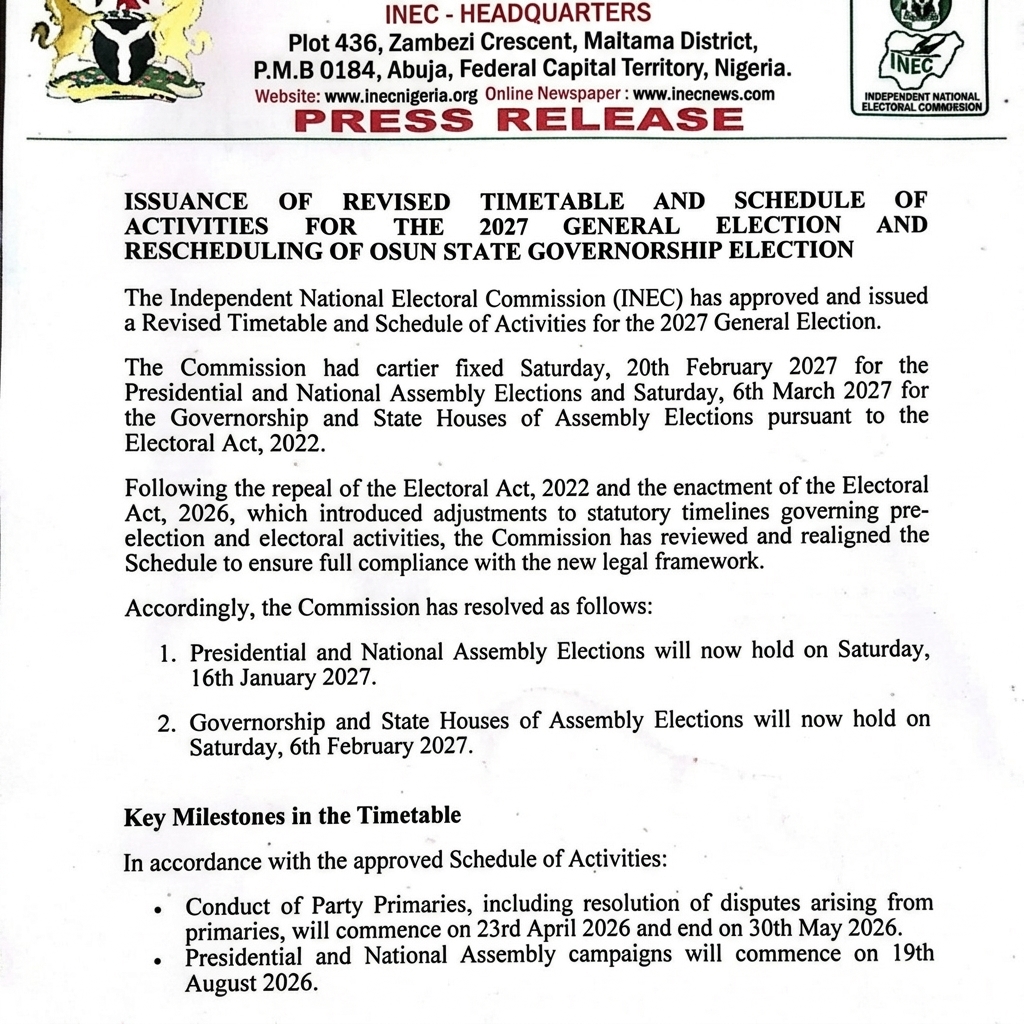
The economic effects of an election begin long before election day. According to INEC’s revised timetable, the presidential and National Assembly elections are scheduled for 16 January 2027, with governorship and State Assembly elections on 6 February 2027.
Party primaries and candidate selection intensify political financing. The campaign season increases spending on advertising, logistics, events and mobilisation. The election period itself brings uncertainty around outcomes and possible short-term market volatility. The post-election transition is often the most important phase for investors, as they assess appointments, budget priorities and the new administration’s commitment to existing policies.
An election victory does not automatically translate into investor confidence. Investors want to see whether the incoming administration will maintain policy consistency and honour the institutional and contractual arrangements that underpin investment. Many investment decisions are made months after the vote, once the actual economic direction becomes clearer.
How Businesses Experience an Election Year
Election cycles affect businesses through several channels. Companies that depend on government contracts may see an acceleration of project announcements, but they also face risks of delayed payments and administrative transitions. Campaign spending injects money into transportation, printing, advertising, media, events and logistics, creating short-term commercial opportunities. That demand should not be mistaken for a sustainable rise in household consumption or productive activity.
Increased political financing can also generate additional foreign-exchange demand. More significantly, companies considering large capital expenditure often become cautious. A manufacturer may postpone expansion. A foreign investor may delay a final investment decision. An infrastructure developer may seek stronger contractual protections.
Election-related uncertainty can also increase the option value of waiting. In investment economics, businesses sometimes postpone irreversible capital expenditure until uncertainty surrounding future policies, taxation, regulation and government priorities becomes clearer. This does not mean that investment disappears; rather, some commitments are deferred. For an economy seeking accelerated industrialisation, the cumulative effect of postponed investment decisions can be significant. The overall result can be a slowdown in investment commitments even when GDP growth remains positive.
What Economic Institutions Are Saying
Nigeria’s economic institutions and professional services firms have increasingly recognised election-related spending as a macroeconomic risk.
The Centre for the Promotion of Private Enterprise, in its July 2026 outlook, identified heightened political activity ahead of 2027 as a downside risk that could inject liquidity and affect inflation and foreign-exchange management.
PwC’s August 2026 Nigeria Economic Outlook highlighted pre-election spending as an upside risk to inflation, even while projecting growth of approximately 4.2 percent for 2026.
Deloitte’s West Africa economic outlook noted election-related fiscal pressures and reform fatigue as risks for 2027, observing that financial markets may become more sensitive to political developments and that some investors may adopt a wait-and-see approach.
These assessments show that election-related economic risks are now standard considerations in forecasting and investment analysis.
Key Indicators Investors Should Watch
| Indicator | Why It Matters to Investors |
| Exchange-rate stability | Determines import costs, repatriation risks and naira asset value |
| Inflation trajectory | Influences interest rates, purchasing power and operating costs |
| Government borrowing | Signals fiscal pressure and competition for domestic credit |
| Foreign direct investment | Measures confidence in long-term productive projects |
| Foreign portfolio flows | Shows appetite for Nigerian financial assets |
| Capital expenditure execution | Indicates real investment in productive infrastructure |
| Policy continuity | Determines whether existing reforms and contracts remain credible |
On 16 November 2026, Reuters reported that annual headline inflation had moderated to 14.06 percent in October from 14.63 percent in September, with food inflation also declining. Lower inflation is encouraging, but it does not mean prices have returned to earlier levels. The test is whether the improvement can be sustained through an election cycle.
Three broad scenarios remain possible: policy continuity under the current administration, a political transition that preserves key reforms, or a higher-risk outcome involving significant policy uncertainty and fiscal expansion. Investor confidence depends not only on political continuity but on institutional continuity.
What Nigeria Should Do Differently
Elections are essential to democratic governance. The objective is to prevent electoral competition from undermining macroeconomic stability. Stronger campaign finance transparency, protection of monetary policy independence, sustained fiscal discipline, credible guarantees of policy continuity, better quality of government spending, deeper domestic capital markets and a clear post-election economic framework would all help.
Nigeria needs institutions, businesses and financial markets that can operate across successive political cycles. A country aiming for a $1 trillion economy cannot afford to have investors reassess the fundamentals every four years. The real measure of economic progress is not simply how well one administration performs. It is whether the institutions and opportunities it leaves behind can support continued development under the next.
Conclusion
Nigeria enters the 2027 election cycle with both economic improvements and persistent vulnerabilities. The political calendar introduces additional uncertainty around fiscal management, liquidity and investment timing.
None of the negative outcomes is inevitable. The election could equally demonstrate that Nigeria has developed the institutional capacity to maintain economic stability through a democratic transition.
That outcome requires fiscal discipline, policy consistency, transparent political financing and institutions capable of operating independently of electoral interests.
Nigeria’s greatest economic achievement would not be an election victory for any particular administration. It would be the development of an economy in which capital can be committed confidently, businesses can plan beyond electoral cycles, and institutions can sustain credible policies regardless of who occupies political office.
The real test of Nigeria’s economic maturity is not whether its economy performs well under one government, but whether it can continue progressing under the next.
Follow Amebopreneur for the latest on Nigeria’s tech ecosystem, startup funding opportunities, and the cross-border partnerships shaping Africa’s innovation future.
Related Posts

UAC Nigeria’s Revenue Jumps 228% to ₦523bn as C.H.I. Acquisition Expands Business
UAC Nigeria’s revenue surged 228% to ₦523bn as the C.H.I. acquisition boosts growth, strengthens its food portfolio and reshapes its business.

OPay Withdraws Planned US IPO: What Does It Mean for the Fintech’s Growth Plans?
OPay’s $304 million US IPO was withdrawn just hours after pricing, raising questions about regulatory scrutiny, investor confidence and the fintech’s next growth move.
MTN Nigeria and Airtel Increase Network Spending as Data Demand Grows
MTN and Airtel are ramping up network investments as Nigeria’s data demand surges, intensifying competition for faster, more reliable internet.

PEBEC Intensifies Push to Make Nigeria Easier for Business Under New Leadership
PEBEC is stepping up reforms to cut bureaucracy, streamline government services and make doing business in Nigeria faster, easier and cheaper.

Beyond Traditional Savings: The Smart Path More Nigerians Are Taking Toward Real Wealth Creation
As inflation erodes the value of idle cash, more Nigerians are looking beyond traditional savings to smarter investment options that build lasting wealth.