

Eyes In The Sky: Drone Technology in Nigeria, Opportunities, Challenges, and the Future
In recent years, Nigeria has seen a substantial increase in the usage and development of drone technology, commonly known as unmanned aerial systems (UAS). What was once thought to be a specialised or military-focused technology is now rapidly spreading throughout numerous areas of Nigeria’s economy. Drones are revolutionising businesses across the country, from agriculture and logistics to security, filmmaking, and infrastructure monitoring. As emerging technologies continue to affect the global economy, Nigeria’s booming drone ecosystem exemplifies the opportunities and problems that come with technological advancement in a developing nation.
The emergence of drone technology in Nigeria
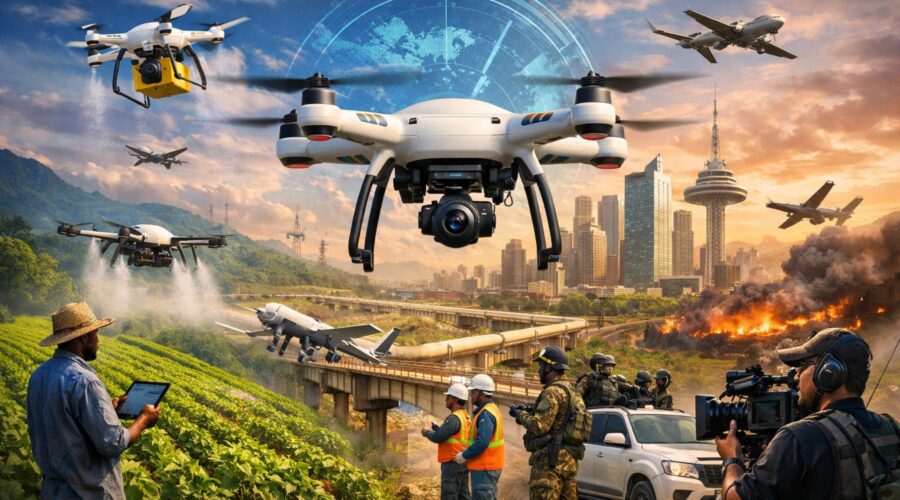
Drone technology in Nigeria first gained popularity for military and security purposes. However, the civilian and commercial sectors gradually recognised the potential of unmanned aerial vehicles to increase efficiency, lower operational costs, and give new data-driven insights. Drones are now widely utilised for aerial photography, land surveys, agricultural monitoring, construction mapping, and infrastructure inspection.
The fast deployment of drones is part of a larger worldwide trend toward automation and digital transformation. Nigeria is increasingly catching up with this trend, as both private enterprises and government organisations investigate the potential of drone technologies.
In Nigeria, the usage of drones has grown, notably in industries that require aerial data collecting and monitoring. Infrastructure companies use drones to monitor bridges, roads, pipelines, and electricity lines instead of dangerous manned inspections.
The construction and engineering industries are also using drone technology for site mapping and surveying. Traditionally, land surveying required a large amount of personnel and time, but drones now enable engineers to make precise topographic maps in hours. These skills lower project expenses while improving project planning.
Furthermore, Nigeria’s film and media industries have adopted drones as an effective storytelling tool. Aerial cinematography has been a common feature in many Nigerian films, especially in the country’s burgeoning entertainment industry.
Government policy and regulatory framework
As drone usage grew, the Nigerian government recognised the need to regulate the industry to ensure its safety, security, and correct integration into national airspace. The Nigerian Civil Aviation Authority is the major regulatory authority for drone activities in Nigeria.
Drone regulations were enacted under Nigerian aviation legislation to govern the operating of remotely controlled aircraft. These regulations require operators to register their drones, receive a remote pilot licence, and follow airspace limits. Individuals operating drones weighing 250 grams or more must register them and complete licence requirements before they can legally fly.
However, managing a quickly expanding technology has proven difficult. Aviation experts admit that global certification requirements for drones are still evolving, making it difficult to construct a fully standardised regulatory framework. As a result, Nigeria has had to develop regulatory norms specific to its local context.
In response to the rapidly increasing drone ecosystem, the Nigerian government has lately begun to create a comprehensive national policy framework for the unmanned aviation business. This policy initiative seeks to coordinate stakeholders, enhance laws, and foster an investor-friendly climate that promotes innovation while adhering to safety standards.
The proposed framework is intended to supplement existing aviation laws and provide more structure to the industry. It would also assist in defining operating categories for drones based on weight, complexity, and intended use, assuring improved control of Nigeria’s airspace as drone traffic grows.


Security and military applications
Beyond commercial applications, drone technology is crucial to Nigeria’s national security. Drones are commonly employed for surveillance, reconnaissance, and border monitoring missions. These unmanned systems allow security agents to scan broad areas without putting people at danger.
Nigerian authorities are also investigating counter-drone technologies in response to possible concerns posed by unauthorised drones. Security services are developing technology to detect and neutralise drones that could pose a threat to critical areas such as airports, government sites, or military installations.
The incorporation of drones into national defence systems mirrors a larger worldwide trend in modern warfare. As unmanned technology advance, governments are making significant investments in drone capabilities for information gathering and tactical operations.
Drones are getting more intelligent and self-sufficient as technology advances.
Conclusion
The introduction of drone technology in Nigeria is an important step toward a more technologically advanced and data-driven economy. As drones become more accessible and adaptable, they are revolutionising industries such as agriculture, construction, security, and entertainment. The government’s efforts to build comprehensive regulatory frameworks show a growing acknowledgement of the technology’s economic and strategic implications.
However, various difficulties must be overcome before Nigeria can fully realise the potential of drones and future technology. Clearer regulations, improved infrastructure, and increased investment in training and research are critical for long-term growth. By making way for an atmosphere conducive to innovation, Nigeria may position itself as an African drone technology leader.
Finally, drones are more than just flying robots; they are part of a larger technology revolution that is changing the way civilisations operate. If properly controlled and integrated, drone technology has the potential to play a critical role in Nigeria’s digital transformation, boosting economic development, improving public services, and creating new opportunities for innovation in the coming years.
Related Posts

Political Dynamics, Global Realignment: What Tola Adeyemi Told CEOs at FNCCI-KPMG Luncheon Series 6
As Nigeria heads toward the 2027 election, KPMG’s Tola Adeyemi urges businesses to prepare for multiple outcomes, policy shifts and new opportunities.

NITDA Builders Festival 2026: Smart Way to Unlock Startup Opportunities
NITDA Builders Festival 2026 offers Nigerian startups a path to ₦3bn in potential investment and pilot contracts by connecting real solutions with institutions.

Nigeria’s Internet Traffic: The Essential Growth Drivers Behind a 168% Surge
Nigeria’s internet traffic surged 168% in three years. Discover the key drivers behind the growth and what it means for businesses, SMEs and entrepreneurs.

Konga And Defence Headquarters Launch Nationwide Discount Scheme for Serving, Retired And Veteran Military Personnel
Konga and Defence Headquarters launch a nationwide discount scheme giving serving, retired and veteran military personnel access to essential goods at reduced prices.

Askya Offers African AI Startups Up To $200,000 In Investment Through New Growth Platform
Askya Investment Partners has launched a six-week AI Growth Platform for 10 African startups, offering zero-equity participation, business support and potential investment of up to $200,000