

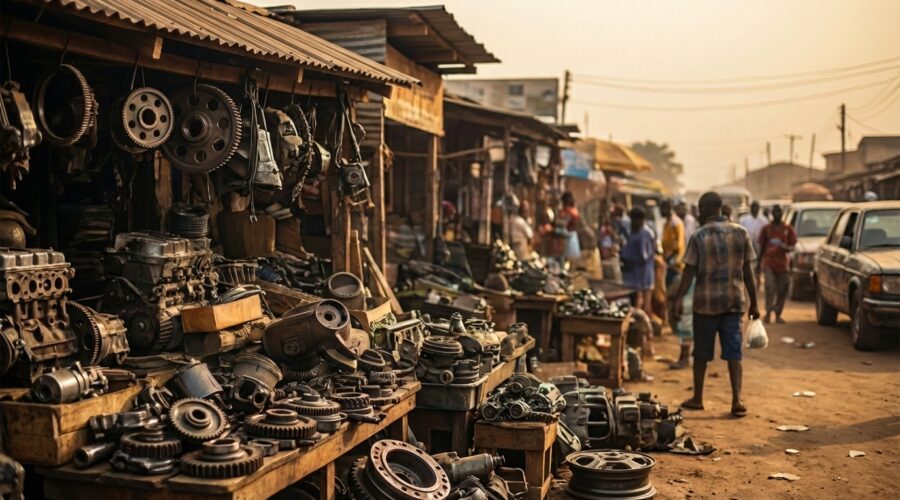
Nigeria Spare Parts Market Unlocks $5 Billion Potential
The Nigeria Spare Parts Market is poised for growth and is no longer just a graveyard for used cars; it is a $5 billion frontier for industrial growth. With 12 million vehicles on the road and a massive “used-to-new” car ratio of 131 to 1, the demand for maintenance has reached a fever pitch.
While Nigeria has long relied on imports, spending trillions of Naira annually on everything from brake pads to batteries, a shift is happening. Between government-backed localization and the rise of “on-demand” manufacturing, the window for investors to move from importers to builders is wide open.
According to the West Africa Automotive Show (WAAS), Nigeria accounts for 75% of the total vehicle fleet in West Africa. However, our reliance on the “Tokunbo” (second-hand) economy comes with a price.
“Nigeria’s automotive spare parts market is estimated at approximately $5–$6 billion annually. Of this, roughly 70–80% consists of new OEM and aftermarket components, while 20–30% comes from second-hand (tokunbo) parts,” says Okpamen Obasogie, a leading mechanical engineer and industrial designer.
This dependency on aging vehicles creates a perpetual cycle of repair, but Obasogie warns that the current fragmented supply chain and high counterfeit rates “significantly delay repairs and hinder the overall efficiency of the industry.”
The old model of simply “copying and importing” is being challenged by a new generation of automotive designers who see the problem as a lack of innovation, not just a lack of factories.
“Nigeria’s spare parts dependency isn’t just an import problem; it’s a design and systems problem,” says automotive designer Bonire Kayode. “If we rethink how parts are engineered from the start, designing for additive manufacturing and digital libraries will redefine the supply. We won’t just substitute imports, we wiil redefine the supply chain. Execution will separate observers from builders.”
Top Investment Opportunities in Nigeria’s Spare Parts Market for 2026
| Sector | Opportunity | Why Now? |
| Component Manufacturing | Brake pads, filters, batteries, and suspension systems. | High turnover rates due to Nigeria’s challenging road conditions. |
| Tech-Enabled Services | Specialized diagnostic centers and 3D printing hubs. | Shift toward precision repairs to manage rising vehicle costs. |
| Supply Chain Solutions | Blockchain-backed traceability for genuine parts. | Urgency to eliminate the high counterfeit rate in the market. |
Nigeria’s Spare Parts Market: Policy Initiatives and Opportunities
The National Automotive Design and Development Council (NADDC) is no longer just observing. Director-General Joseph Osanipin is actively pushing to move local assembly capacity from less than 1% to 40% by prioritizing 10 essential vehicle components for domestic production.
“To stimulate demand for locally made automobiles, issues of spare parts and maintenance must be tackled head-on,” Osanipin noted, urging local manufacturers to establish more maintenance workshops and factories to avoid jeopardizing the sector’s growth.
Osanipin’s strategy is clear: transition from a policy framework to a formal Act of Parliament to give investors the “legal certainty” they need to commit $3–$4 billion into large-scale plants.
The future of the Nigeria Spare Parts Market may lie in the Fourth Industrial Revolution (4IR). Obasogie argues that Additive Manufacturing (3D printing) and reverse engineering present a “transformative opportunity” for Nigeria.
“These technologies enable localized, on-demand production of components, laying the foundation for broader industrial growth. More importantly, they create a platform for upskilling engineers in advanced digital design and precision fabrication,” Obasogie adds.
Nigeria’s spare parts market is a goldmine hiding in plain sight. For investors, the play is simple: stop funding the logistics of other nations and start building the infrastructure of ours. With FX pressures making imports more expensive, the “Made in Nigeria” label isn’t just a matter of pride—it’s the only sustainable economic path forward.
Related Posts

NITDA Builders Festival 2026: Smart Way to Unlock Startup Opportunities
NITDA Builders Festival 2026 offers Nigerian startups a path to ₦3bn in potential investment and pilot contracts by connecting real solutions with institutions.

Nigeria’s Internet Traffic: The Essential Growth Drivers Behind a 168% Surge
Nigeria’s internet traffic surged 168% in three years. Discover the key drivers behind the growth and what it means for businesses, SMEs and entrepreneurs.

Konga And Defence Headquarters Launch Nationwide Discount Scheme for Serving, Retired And Veteran Military Personnel
Konga and Defence Headquarters launch a nationwide discount scheme giving serving, retired and veteran military personnel access to essential goods at reduced prices.

Askya Offers African AI Startups Up To $200,000 In Investment Through New Growth Platform
Askya Investment Partners has launched a six-week AI Growth Platform for 10 African startups, offering zero-equity participation, business support and potential investment of up to $200,000

Cabo Verde Telecom and DE-CIX Plan New South Atlantic Connectivity Corridor
DE-CIX and Cabo Verde Telecom have signed a non-binding Letter of Intent to explore a South Atlantic connectivity corridor linking Lisbon and São Paulo, strengthening direct digital infrastructure across Europe, Africa, and Latin America.